Wednesday, June 18, 2025

Weak Brothers XXII


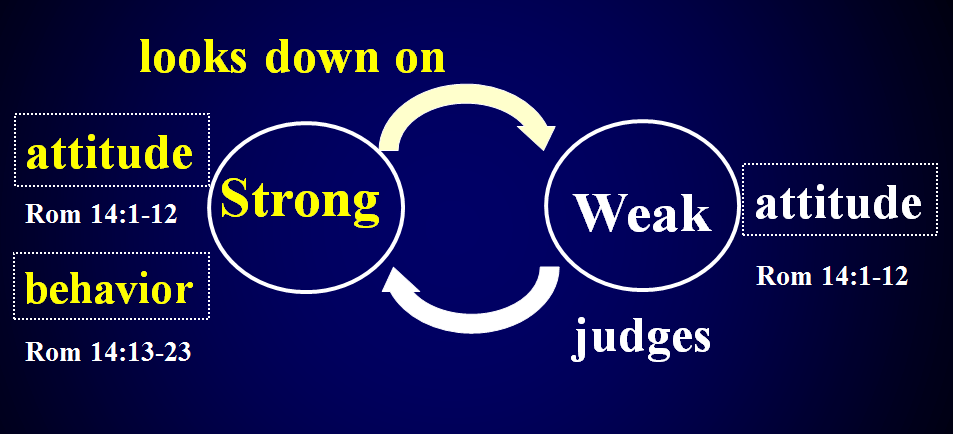
As we have seen so far in our examination of Romans chapter fourteen Paul has something to say to both the weak and the strong, although he has more to say to the strong. He speaks to each class of religious persons relative to the attitude and behavior that each shows towards the other. The above chart illustrates this narrative. We have also seen how certain things that Paul says in this chapter are crucial in arriving at a right interpretation and in discerning whether the weak brothers are Christians who hold to errors about religious dietary laws and observance of holy days and religious feasts and such like. My thesis has affirmed that the weak ones of Romans chapter fourteen are the same class of individuals as the weak ones of first Corinthians chapters eight through ten and that they are not Christians or truly born again children of God. They are rather devout religious folks who are generally polytheistic, although they would include Jews who have not yet believed in Jesus but who are willing to listen to the Christian message. 

We have given extensive commentary on the first six verses of Romans chapter fourteen and on Paul's conclusion as given in the first verse of chapter fifteen. From verse seven to the end of the chapter will now command our attention, although as will be seen, there is less need for elaboration on these verses as there is on the first six verses. 

We Are The Lord's

"For none of us lives to himself, and no one dies to himself. For if we live, we live to the Lord; and if we die, we die to the Lord. Therefore, whether we live or die, we are the Lord’s. For to this end Christ died and rose and lived again, that He might be Lord of both the dead and the living." (vss. 7-9)

Many Bible teachers have said something that I have also often stated to Bible students. It is not the big words in the bible that give a student the most difficulty in interpretation but the little words and this is true in regard to discerning who is intended by pronouns in a text. We have already observed this problem in this chapter, such as interpreting who is the "him" in the words "for God has received him." The same is true in the above verses. Sometimes in Romans chapter fourteen Paul will speak directly to the strong and sometimes directly to the weak and sometimes to each class of persons at once. Obviously some things Paul says to each group of religious folks will not be appropriate or applicable to the other group. So then, who is intended by the pronouns in the above verses, by the pronouns "us" and "we"? When Paul says "none of us" does he mean "none of us Christians, i.e. none of us strong ones," or "none of us human beings, whether weak or strong"?  

Another thing to discern is who is "the Lord" in the text? As we saw in our analysis of verses 5-6 there was no definite article before "lord" and showed that this was important and saw how the lord of the weak was not the same lord of the strong, just like we saw how the "master" of the weak and strong was not the same, for that is deducible from Paul's question to the weak which said "who are you to judge another Lord's servants?" So, it is important to discern to whom Paul is addressing in the verses above.

It is clear to me that Paul is addressing the strong ones, which I have identified as being believers in Jesus and they who are under the new covenant. What he says to them is not applicable to the weak ones. In these verses we see how the definite article "the" precedes "Lord," unlike verses 5-6 that omitted the definite article. This indicates to us that the Lord of the strong ones is the Lord Jesus Christ

Wrote Dr. Albert Barnes in his commentary:

"No man - No "one," the same Greek word οὐδείς oudeis which is used in the former part of the verse. The word is used only in reference to "Christians" here, and makes no affirmation about other people."

That is true, but are the religiously sick and impotent Christians? My thesis says not, although it is a minority view. Of course, that is no proof that it is wrong for the majority is often wrong. 

What does Paul mean when he says "none of us lives to himself and no one dies to himself"? When Paul says "none of us" Christians he is asserting something that is true of everyone who is a true believer. What is it that is universally true about every believer? Is he saying that none of us are hermits? Does he mean that none live in isolation from the world? No, that is not what he means. It is impossible to live in total isolation. Wrote Paul:

"I wrote to you in my epistle not to keep company with sexually immoral people. Yet I certainly did not mean with the sexually immoral people of this world, or with the covetous, or extortioners, or idolaters, since then you would need to go out of the world." (I Cor. 5: 9-10 mkjv)

Paul says that as long as we live in this world that we must have dealings with unsaved people. Further, it is not the Lord's will that his people become monks, to withdraw from the world. Rather, Jesus said "go into all the world and preach the gospel to every creature." (Mark 16: 15 nkjv)

Paul also means that the Christian has a law written on his heart which forbids living selfishly. He emphasized this more than once. He wrote:

"Let each of you look not only to his own interests, but also to the interests of others." (Phil. 2: 4 esv)
"Let no one seek his own good, but the good of his neighbor." (I Cor. 10: 24 esv)

Christians have the mind of a servant. Repentance denotes a change of mind and occurs when the person who once desired lordship over others becomes one who desires to serve others, especially in the sense of winning others to Christ. Said Jesus:"Yet it shall not be so among you; but whoever desires to become great among you, let him be your servant." (Matt. 20: 26 nkjv)

For the strong ones (Christians) not to be desirous of, and not doing all they can for, the salvation of the religiously sick (i.e. the lost), is totally out of place. Recall that Paul said:

"For though I am free from all men, I have made myself a servant to all, that I might win the more...To the weak I became as weak, that I might win the weak. I have become all things to all men, that I might by all means save some." (I Cor. 9: 19, 22 nkjv)

Throughout Romans chapters fourteen and fifteen and First Corinthians chapters eight through ten, Paul has much to say to the strong ones (true believers) about their attitude towards the weak and how to act towards them so that they too might become strong Christians. Notice his summation in Romans:

"We who are strong have an obligation to bear with the failings of the weak, and not to please ourselves. Let each of us please his neighbor for his good, to build him up. For Christ did not please himself, but as it is written, “The reproaches of those who reproached you fell on me.” (Rom. 15: 1-3 esv)

We have already commented on these words to some extent. We pointed out how those who Paul called weak "brothers" he here calls neighbors.

I can see how some of the first Christians had an attitude similar to the Pharisees in looking down on those of other religions, thinking themselves superior to those who worship idols and other gods.

The phrase “holier than thou” generally refers to an attitude of spiritual superiority or self-righteousness. It conveys an air of condescending moral high ground, in which someone views himself as being more pious, more faithful, or more deserving of God’s favor than others. The English expression often traces its roots to Isaiah 65:5 in older translations, though the essence of the concept-presuming a lofty moral or spiritual position-runs throughout Scripture. The Isaiah passage speaks of those "Who say, ‘Keep to yourself, Do not come near me, For I am holier than you!’" This is disgusting to God. This attitude is seen in Jews who looked upon Gentiles as dogs and as unclean. Even the apostle Peter had this attitude when he refused to associate with Gentiles. The Lord had to show him how Christians are to have another attitude and behavior towards the religiously sick. 


Tuesday, June 17, 2025

Weak Brothers XXI


"One person esteems one day above another; another esteems every day alike. Let each be fully convinced in his own mind. He who observes the day, observes it to the Lord; and he who does not observe the day, to the Lord he does not observe it. He who eats, eats to the Lord, for he gives God thanks; and he who does not eat, to the Lord he does not eat, and gives God thanks." (vs. 5-6)

We have already given Commentary on verses 1-4 of Romans chapter fourteen and on verse one of Romans chapter five. On the two above verses I have already given Commentary. See chapter fifteen in our series (here).

Does Paul, in the above words, condone keeping religious diets and observing holy days? Does he legitimize such for Christians under the new covenant? Or, does he condemn such? Or, is he neutral on the point?

Is Paul's position one that says: Observing religious diets and holy days are not commanded by God in the new testament period. yet if a believer thinks God still delights in his people keeping those observances then it is okay and beneficial? I find that explanation of what Paul says hard to believe. Such a view in effect says that Paul saw no harm in keeping holy days and religious diets. Yet, as we have seen, Paul has much to say on the subject and always taught that such things are out of place under the new covenant. 

"So let no one judge you in food or in drink, or regarding a festival or a new moon or sabbaths, which are a shadow of things to come, but the substance is of Christ." (Col. 2: 16-17 nkjv)

"But then, indeed, when you did not know God, you served those which by nature are not gods. But now after you have known God, or rather are known by God, how is it that you turn again to the weak and beggarly elements, to which you desire again to be in bondage? You observe days and months and seasons and years. I am afraid for you, lest I have labored for you in vain." (Gal. 4: 8-11 nkjv)

It is hard to argue that Paul is strictly alluding to law keeping Jews when he speaks of those who consider observing religious diets, holy days, feasts, Sabbaths, etc., for surely he includes religious Gentiles (who were mostly polytheistic), and probably has them chiefly in mind. In my former commentary on Romans 14: 5-6 I affirmed this and cited other Bible commentators who agreed. In that chapter I wrote the following on the Galatian's passage:

"Are these words chiefly addressed to converted Jews or converted Gentile pagans? This is an important question in understanding what class of religious practice the apostle alludes to when he refers to "observing days, months, times, and years." The Jews, by the direction of God, had a religious calendar. But, polytheistic Gentiles also had such. Is one or the other, or both, condemned by the apostle? The same question may be asked about the "impotent ones" of Romans 14. As was shown in the previous chapter, it is unlikely that the apostle had Jewish (Torah) observances in mind, in Romans 14, seeing he mentions religious vegetarianism, which the Torah did not promote. He seems rather to be alluding to Gentile (pagan) rituals and observances."

The Galatian churches were overwhelmingly composed of converted Gentiles. When he asks why "turn again to the weak and beggarly elements, to which you desire again to be in bondage" the descriptive language and phraseology seems more appropriate of those who came out of polytheism rather than Judaism, although the religious general principle of belief or practice the apostle is denouncing and rejecting as part of the new covenant applies to both Judaism and Polytheism

In that same chapter I cited these words from other Bible teachers and commentators:

"Interestingly, Paul connects a return to religious observance of "days, months, times, and years," as a return "to the weak (impotent) and beggarly elements" that put one into "bondage." What does he mean by "the weak and beggarly elements"? Forerunner commentary says that the expression is "referring to the demonism they had been involved in prior to their conversion." It also says: "The Gentile Galatians were observing certain days, months, seasons, and years that had nothing to do with God's holy days..." Commentator David B. Grabbe says - "The "days and months and seasons and years" of verse 10 do not refer to God's holy days, but rather to pagan, Gentile holidays that the Galatians observed before conversion in service to "those which by nature are not gods," as verse 8 says." Further, he says - "Thus, the "days and months and seasons and years" is not something Paul wrote in reference to the law of God or even to Judaism. Instead, they are something apart from both of them."

Yes, Paul addresses the Galatians as those who observed such holy days and religious diets, for he says that they once served "those which by nature are not gods." That is a reference to Gentile polytheism.

"In those places, in the Pauline epistles, where Paul speaks of observing religious dietary laws and religious days, it is in the context of pagan observances, not in the context of Torah observances. This was the case in I Corinthians chapter eight, the case in Galatians chapter four, and in this passage, again addressed chiefly to converted pagans."

What does Paul mean when he says that religious diets and holy days in the old testament were "a shadow of things to come, but the substance is of Christ"? Paul wrote similarly to the Hebrews, saying "The Law had a shadow of good things to come, not the very image (or, substance) of the things” (Heb. 10: 1). Christians have the substance and old testament believers had a shadow of that substance, or as it is stated in the Book of Hebrews, the old testament's various rites and ceremonies were figures, types, symbols, examples, of what is now a reality in Christ under the new covenant.

Wrote John Gill in his commentary:

"Which are a shadow of things to come,...By Christ, and under the Gospel dispensation; that is, they were types, figures, and representations of spiritual and evangelical things: the different "meats and drinks", clean and unclean, allowed or forbidden by the law, were emblems of the two people, the Jews and Gentiles, the one clean, the other unclean; but since these are become one in Christ, the distinction of meats is ceased, these shadows are gone...The "holy days", or "feasts" of the Jews, the feasts of tabernacles, of the Passover and Pentecost, were types of Christ."

Mormons teach that a person cannot be a member in good standing if he drinks tea or coffee. In Catholicism, abstaining from meat on Fridays, particularly during Lent, is a tradition. But these have no validity in Christ under the new covenant (testament). The keeping of the weekly Sabbath is also no longer binding on Christians for it was a shadow of something greater under the new covenant. Christ is the Lord of the Sabbath and says that if one comes to him he will enter into Sabbath rest and enjoy Sabbath blessings every day.

Which Lord or God?

This question was asked previously when we addressed Paul's statement "for God has received him." We showed that the "him" was the strong one who did not believe in religious diets and holy days although some think "him" may be refer back to both the weak and the strong. Now we come to a place in the chapter where we must ask "is the Lord and God of each religious servant the same in verses 5-6 at the head?" We have already seen how Paul distinguishes who is the "master" of each weak or strong servant? We showed how the master (synonym for Lord, God) of the weak was not the same as the strong, deducing that from the words "to his own master he stands or falls."

In my previous writing on these verses in chapter fifteen of this series I made these important observations that are needed in properly translating or interpreting the text of Romans 14: 5-6:

"Some commentators feel compelled to make "the impotent" to be Christians because Paul seems to them to be affirming that they serve the same "lord." He that observes religious diet and calendars does it "to the lord," and he that does not observe it also "to the lord" refrains. The commentators think the same "lord" is under consideration and conclude that both must be Christians because they practice such, or refrain from practicing such, to the same "lord." But, this is not the case. The "lord" and "god" is not the same and the context shows this to be so."

"First, as was seen in the previous chapter, Paul asked - "who are you (impotent ones) to judge (condemn) another man's (another lord's) servant?" This language is unmistakeable in showing that the "lord" of the "impotent" was not the same "lord" as the "potent." So, in the verse now under consideration, the same distinction is made. Second, the definite article "the," before the word "lord," is missing in the text, a fact that most translations fail to appreciate. In fact, most translations put the definite article into the text. Thus, they translate - "He that regardeth the day, regardeth it unto the Lord; and he that regardeth not the day, to the Lord he doth not regard it. He that eateth, eateth to the Lord, for he giveth God thanks; and he that eateth not, to the Lord he eateth not, and giveth God thanks." Also of interest is the fact that most translators not only put the definite article before "lord," which is however absent in the Greek text, but omit the definite article before the word "god," which is however present in the Greek.

The Greek language had no "a" or "an," no indefinite article. The absence of the definite article, however, signifies the indefinite. Also, the word for "lord" and "god" do not come with a capital letter beginning the word...most translations capitalize the first letter, giving the reader the impression that the reference is not to a pagan "lord" or "god," but to the Lord and God of Christians. We can thus read the passage thusly:

"He that regardeth the day, regardeth it unto a lord; and he that regardeth not the day, to a lord he doth not regard it. He that eateth, eateth to a lord, for he giveth the god thanks; and he that eateth not, to a lord he eateth not, and giveth the god thanks." 

What message is Paul sending in the words "let each be convinced in his own mind"? The words "let each" show that he is addressing both classes of persons, one who observes holy days and one who does not. Recall how we discussed the words "for God has received him" and asked whether the "him" was the weak or the strong. We asked why Paul did not say "received each." After all, he does use "each" in the above words "let each be convinced." As we have previously stated, Paul addresses each class of persons in Romans chapter fourteen although he addresses the strong ones more times. Sometimes he speaks to the weak and sometimes to the strong and sometimes to both. 

Of what does the apostle want each class of persons to be convinced? If diet and observance of holy days are not worth discussing, or are irrelevant and unimportant things, then why exhort both classes to be certainly assured of their beliefs about such things? This exhortation therefore demonstrates the error of many who say that the issue of religious diet and holy days are "things the bible says nothing about."

In chapter fifteen I wrote this about what he means when he says "let every man be fully persuaded in his own mind," saying - 

"he does not mean "let every Christian be fully persuaded in his own mind," but "every man," converted or unconverted, pagan or Christian. The Christian is persuaded that his Lord and God does not require him to observe religious diet and holy days. Paul wants the pagan to see that "food commends us not to God, for neither if we eat, are we the better, and neither, if we don't eat, are we the worse." He wants the pagan and the Christian to discuss this and come to agreement. He does not want any to think that observance of holy days and religious diet is a "matter of indifference" or "something the bible says nothing about." The Christian should seek to convert the pagans from his thinking regarding religious diet and calendars, to see that such things affect not a man's standing with God. The Christian is not to "despise" the pagan for his beliefs, but this does not mean that he does not seek to convert him from his false religion. On the other hand, Christians should use the argumentation of the apostle in confronting those pagans who "judge" or condemn the Christian for having no laws regarding diet and holy days."


Sunday, June 15, 2025

Weak Brothers XX


In previous chapters I raised the question of whether it would make a difference in how people interpret what is said of the weak and strong if the Greek word for "weak" were translated the way it is in other places in the new testament, such as by the word "impotent," "sick," "diseased." But let us do the same with the word "strong." Being the antonym of "weak" it means healthy, sound, wholesome, fit, potent, etc. We may then paraphrase Paul's message as: "the religiously healthy should receive the religiously sick." 

At the end of Paul's teachings on the weak and strong he concludes by saying: "We then that are strong ought to bear the infirmities of the weak, and not to please ourselves." (15: 1) In this text the Greek word for "infirmities" is "asthenēma" (a form of the Greek word for "weak") but this time a different Greek word for "weak" is used, being "adynatos" and meaning without strength, impotent, powerless, weakly, disabled, or impaired. Such adjectives cannot possibly be appropriate for true Christians or saved people. They are fitting adjectives, however, for devout religious people who are not Christians, and even for some who are professing Christians and are hypocrites and not really saved. Therefore, to the extent that churches have such in their churches they may be said to have weak/sick Christians. When Paul refers to the "infirmities" of the religiously sick, he does not mean physical infirmities, but religious infirmity in matters of theology. 

"Infirmities of the weak" would be set in contrast to "the strengths of the strong." Here are some ways others translate the phrase:

"the failings of the weak" (niv, esv)
"shortcomings of the weak" (bsb)
"the weaknesses of the weak" (blb)
"the scruples of the weak" (nkjv)
"the weaknesses of those without strength" (nasb)

The Greek word for "strong" is dynatos and means "able" or "capable." That being so, the antonym of strong would not only be "weak" but "unable." 

In the preceding chapters we saw how the Greek word for "weak" in Romans 14 was translated in other places by "sick," "impotent," and "diseased." So, why do translators and Bible commentators not use these words in Romans or Corinthians when speaking of the "weak"? In the above text (Rom. 15: 1) the plural of the word "weak" (Greek "astheneo") is used (English "weaknesses" or Greek "asthenēmata"). In the plural we get "weaknesses," "infirmities," "scruples," "failings," "shortcomings," but why not sicknesses, or impotencies, or diseases? Especially considering that in far more instances the Greek word is so translated rather than by the word "weak"? I see a bias by translators and interpreters against seeing "the weak" of Romans and Corinthians as being unsaved people. All should acknowledge how coming to the passages dealing with the weak brothers with a presupposition about who they are has affected what English words were chosen to stand in the place of the "weak."

Combining what is said of the weak or infirmed in Romans 14: 1 and 15: 1 we may translate the latter in these ways:

"the weaknesses of the impotent"
"the impotencies of the powerless"
"the sicknesses of the incapable"
"the infirmities of those without strength"

As stated previously, if we simply translated "the weak" as "the sick" or "the impotent" in Romans and Corinthians people might have been led away from assuming that the weak are born again Christians.

Also, had people kept in mind that it is "in faith," or in religious belief or creed, that people are labeled as either weak or strong, sick or healthy, etc., then people might have questioned the common view that avers that "the weak ones" are weak Christians. Those commentators who think that Romans chapter fourteen concerns "things which the Bible says nothing about" or minor differences of opinion will say that the choice to be vegetarian is not within the context of religion; And, if that is so, then it certainly would be a matter of indifference. Likewise, if it is not in a religious context that people are weak or strong, and if food choices are outside of a religious context, and if esteeming certain days as special is not in a religious context, then why would Paul even waste time in his important letter to the Romans to speak about people's choice of food to eat or about their observing special days like birthdays? 

Religiously weak ones are inferior to strong ones. But, if keeping dietary laws and observing holy days has nothing to do with judging one as either weak or strong, not being a criteria, then why are those who observe such labeled weak and those who do not observe such are labeled as strong? It such religious observances have nothing to do with whether one is a weak or strong, being unimportant matters of opinion, then why call one weak or strong in relation to those observances? Further, is that not a judgment? Indeed it is; Therefore Paul is violating his own exhortation, as we have previously noted.  

Are The Weak Jews or Gentiles?

Are the Jews the weak ones of Romans chapter fourteen? If Jews, are they Jews who have rejected Christ or Jews who have accepted Christ but who continue to observe old testament dietary laws and holy days (including their seven annual feasts)? Many commentators say the Weak ones were Jewish Christians in Rome who were newly converted and still held onto certain Jewish customs and dietary restrictions, and observed holy days. They were "weak" in faith because they were still struggling with the transition from Jewish law to Christian freedom. The "strong," on the other hand, were those Gentile Christians or Jewish Christians who were not bound by the same dietary or ritualistic observances. One cannot exclude religious Gentiles from those who are religiously weak, sick, or impotent. In Corinthians it seems rather clear that "weak brothers" were mostly composed of those who were Gentile idol worshipers. Again, there is no reason to think that the weak ones of Romans exclude Gentiles. 

Even though what Paul says in Romans chapter fourteen is primarily directed to the heathen Gentile idol worshipers, nevertheless may be applicable to professing Christians who are not really genuine Christians (saved) or to Jews, either those who have professed Christ or those who rejected Christ. 

"Eats Only Vegetables"

One good argument against the view that "the weak" of Romans are converted Jews who were still keeping old covenant dietary laws and holy days is what Paul says about the weak being strictly vegetarians. "For one believes he may eat all things, but he who is weak eats only vegetables." (14: 2 nkjv) But how can this be true of Jews who were observing the old covenant's rules since there is nothing in the law forbidding meat eating? Many commentators who are determined to see "the weak" as "the weak Jew" will say that Jews who were vegetarian were such from fear of eating meat offered to idols and not because it was what God commanded. Let us notice some commentaries on this point. 

"Eateth herbs - Herbs or "vegetables" only; does not partake of meat at all, for "fear" of eating that, inadvertently, which had been offered to idols. The Romans abounded in sacrifices to idols; and it would not be easy to be certain that meat which was offered in the market, or on the table of a friend, had not been offered in this manner. To avoid the possibility of partaking of it, even "ignorantly," they chose to eat no meat at all." (Barnes) 

This comment is made by Barnes upon the assumption that it is old covenant keeping Jews who are the weak and who, to keep from mistakenly eating meat from sacrifices dedicated to idols, chooses to eat no meat at all. That would be like a Jew who out of fear of having leaven in his house during Passover never has leaven in his house. That would not be the correct reason given the context. The reason why some of the weak eat only vegetables is because eating meat is forbidden by their religion. It seems that such a reason for why the weak eat only vegetables is an effect resulting from the presupposition that the weak are Jews who keep the law and from rejecting the idea that Paul could be describing Gentile religions (which were mostly polytheistic). 

"another who is weak eateth herbs; meaning not one that is sickly and unhealthful, and of a weak constitution, and therefore eats herbs for health's sake; but one that is weak in the faith, and who thinks that the laws concerning the observance of meats and drinks are still in force; and therefore, rather than break any of them, and that he may be sure he does not, will eat nothing but herbs, which are not any of them forbidden by the law: and this he did, either as choosing rather to live altogether on herbs, than to eat anything which the law forbids; or being of opinion with the Essenes among the Jews, and the Pythagoreans among the Gentiles, who thought they were to abstain from eating of all sorts of animals." Gill's commentary)

Though Gill also wants to believe that the weak in the chapter who restrict their diets, such as those who eat only vegetables, and who keep holy days, cannot include Gentiles, nevertheless mentions some Jewish sects who were vegetarians, but also some Gentile pagans who did the same. My view of the weak would include both Jewish and Gentile religious people. Vegetarianism is strongly encouraged and widely practiced within Hinduism, though it's not a strict requirement for all Hindus; And, Hinduism was in existence in the time of Paul. A Google search with the words "vegetarian diets in religion" gives us this AI Overview:

"Many religions incorporate vegetarianism or promote plant-based diets for ethical, spiritual, or health-related reasons. Jainism mandates strict vegetarianism, while Hinduism, Buddhism, and some Christian denominations encourage it to varying degrees. Other religions like Seventh-day Adventists and Rastafarians also have strong dietary guidelines involving vegetarianism or veganism." 

Why then exclude Gentiles from those who are religiously sick (Weak) and "eat only vegetables"? The commentators who say that the reason why the Jews under consideration only eat vegetables was out of fear that they might accidentally eat meat offered to idols is a speculation and one with little reason to support that view. If "the strong ones" includes both converted Jews and Gentiles, why would "the weak ones" also not include both Jews and Gentiles? As I have affirmed, "the religiously sick and impotent ones" in the context focuses primarily on Gentile idol worshipers but may also include Jews, either those who confess and those who do not confess Christ as Messiah. Both the Jews and Gentiles had religious diets and holy days and believed that observing such commended them to God or to the gods. Recall these words of the apostle:

"For though I am free from all men, I have made myself a servant to all, that I might win the more; and to the Jews I became as a Jew, that I might win Jews...to the weak I became as weak, that I might win the weak." (I Cor. 9: 19-20, 22)

Here "Jews" are distinguished from the "weak." 

Neighbors as Brothers

As I have stated in previous chapters, the main argument of those who think that the weak are Christians who have doubts about the Christian faith but are nevertheless saved is the fact that Paul refers to the weak as "brothers" in Corinthians and in Romans. I have already answered this argument by saying that such an argument is not conclusive, especially in view of all the reasons I have offered against that view. I have shown how use of the term brother by Paul did not always mean that Paul viewed them as saved people. I affirmed that he often used the term brother for either fellow Jews who were not saved, and for all his fellow men. In the text at the top from Romans 15, in speaking of the weak brothers, Paul says "each of us should please our neighbors for their good, to build them up," showing how he equated brother with neighbor


Friday, June 13, 2025

Weak Brothers XIX


In this chapter I want to begin by listing the questions Paul asks in Romans chapter fourteen. Following that we will begin a verse by verse analysis, a thing we have already done on several of the verses.

Questions

"Who are you to judge another’s servant?" (vs. 4)

"But why do you judge your brother? Or why do you show contempt for your brother?" (vs. 10)

We need to discern who is designated by the pronouns "you" in these questions. Are they addressed to the strong ones or to the weak ones? Or to both? Next, we need to discern who is intended by "another's servant?" Finally, who is intended by "servant"? The first question may be addressed to either the strong or the weak, but probably is only to the weak. The second question is addressed to the strong. Let us notice the context.

"For one believes he may eat all things, but he who is weak eats only vegetables. Let not him who eats despise him who does not eat, and let not him who does not eat judge him who eats; for God has received him. Who are you to judge another’s servant? To his own master he stands or falls. Indeed, he will be made to stand, for God is able to make him stand." (vss. 2-4)

In this context we see two kinds of believers (religious folks). One believes he may eat all things (no religious diets). Another believes he can only eat vegetables religiously. Each of these believers are also called "servants" and have "masters," religiously speaking. The servant is the worshiper and the master is the god or lord of that servant (or slave). Thus, "another's servant" means another master's/god's servant. This shows that the master is not the same master of both weak believer and strong believer. This is very important to recognize. It is a case of one god's servants judging another god's servants.

Also the words "to his own master (god)" also says that the god of the weak is not the same god as the strong. It would not make sense to see both weak and strong having the same master. This annihilates the view that says the weak and the strong are both servants of Jesus or the same god. That is like saying to a father - "who are you to discipline another father's children? To his own father he gets praised or punished." In that case we have two fathers and children from two families.

Further, who is Paul speaking to when he says "for God has received him"? Who is the "him"? Is he saying that God has received (welcomed) the weak or the strong? Or does the language or syntax infer that both weak and strong are received by God (thus saved children of God)? 

It seems more likely that "him" refers to "him who eats" (Christians or the strong ones who observe no dietary laws) and not to "him who does not eat" (the non Christian religionist or Jew who observes dietary laws) for the words "for God has received him" immediately follows the words "him who eats"; And antecedents of pronouns are normally found near to the pronouns. So we read it this way: "let not the weak judge him who eats for God has received him who eats." If this is correct, and I firmly believe it is, then we have a case where Paul is speaking directly to pagans and addressing their denunciations and persecutions of Christians. Paul has things to say to both the weak and the strong, although his main audience is the strong ones (religiously healthy).

Commentaries disagree on who is the "him" in "God has received him," many saying that the pronoun refers to both the weak and the strong. But, that is wrong for the reasons already given. If that were true, Paul would have used the plural "them" rather than the singular "him." Or, he would have said "for God has received each."

Of course, God receives all who come to him. He invites all to come to him, both weak and strong, in the gospel. But, he actually receives into his fellowship those who have accepted his invitation and come to him through Christ. 

For these reasons I affirm that Paul places two injunctions on the weak ones (religiously sick and impotent), first in the question "who are you to judge another master's servants?"; And second in the exhortation "let not him who does not eat judge him who eats." One of these is an exhortation or command and the other is a rhetorical question which has the effect of an imperative and may be said to exhort the weak not to judge the strong. I believe, therefore, that the first question is directed to the weak ones, to the religiously sick, and is designed to ask them for justification for judging (condemning) the strong ones for their not keeping dietary laws and observing holy days as they do. 

Paul asks the pagans (religiously sick): "is not each religious servant judged by the master/god/lord he recognizes?" Here Paul presumes that the pagan he is addressing will agree with this, being a common principle among the various god cults of the Roman world, and which involves forbearance and tolerance and a sense of fraternity among the various cults. He says, for example: "you servants of the god Apollo are violating your own principle in condemning the servants of the god Jesus for not observing Apollo's dietary laws and holy days, for Christians do not serve Apollo and Jesus does not command such from his servants." Paul shows he is an excellent debater, apologist, and persuader. Paul is saying that it is the right of Jesus to judge his servants and Apollo's servants cannot judge them. "To his own master he stands or falls," means that the strong ones (Christians) are subject to the judgment of Christ and the Christian God they worship, and that the weak ones (false religionists) are subject to the judgment of the masters/gods they worship.

I would translate or paraphrase the text this way: "Polytheist, who are you to judge (condemn, curse, etc.) another's (another god's or lord's) servant?" 

The latter question I believe is directed to the strong ones, to the religiously fit ones. It asks Christians why they judge and condemn, show contempt towards, and despise the religiously sick pagans rather than showing them compassion and attempting to gently persuade them. "But why do you judge your brother? Or why do you show contempt for your brother?"

The two questions that Paul asks at the head of this chapter deal with "who" and "why" (as I highlighted in the verses cited). The rhetorical "who are you" is a way of saying "who do you think you are?" And the intent of the rhetorical is to question the right, authority, or prerogative of the religious cults in Roman and Corinth to judge or condemn the Christian cult. 

"The strong despise the weak; the weak judge the strong. In the one case there is contempt for what is thought to be narrowness and pedantry. In the other case censorious judgments are passed on what is regarded as levity and irreligion." (Elliott's commentary) 


Wednesday, June 11, 2025

Weak Brothers XVIII


In this chapter we will 1) further identify those called "weak in the faith" and 2) examine what the apostle means when he says "not to doubtful disputations" (KJV) or "without passing judgment on his opinions." 

We have already shown that the weak brothers of first Corinthians are not saved Christians, having identified them as non Christian, yet religious friends and neighbors of Christians, and who are mostly polytheists. We have also argued that the weak under consideration in Romans are the same class of folks as in Corinthians.

One should also keep in mind the fact that the polytheists in the Roman world did not object to adding Jesus and Jehovah to the lists of gods who were worshiped. It was not until the Christians promoted the idea that all the other gods and idols were not legitimate that the pagans sought to extinguish Christians. The pagan world reacted vehemently against the exclusive claims of the Christian religion. As we have already stated, Paul was in Athens, Greece, a city full of religion and having numerous altars to all the gods of the Greco-Roman world. There would have been no objection to adding an altar to Jesus and recognizing him as one of the gods. Many of these polytheists would have been open to hearing about another new god since they were always ready to hear anything new. In fact, many such idol worshipers would have been willing to be discipled in the Christian faith. Many of these were call catechumens.

A "catechumen," in the early Church, was the name applied to someone who had not yet been fully convinced of the Christian faith, but was being discipled or schooled with the hope that he would become Christian. These individuals were often converts from paganism or Judaism. This period of instruction, known as the catechumenate, involved learning about Christian beliefs and practices. I have read where special rooms in the meeting houses of Christians were set apart for such folks and for those who were visitors in the church. Paul may allude to that when he writes these words to the Corinthian church:

"Otherwise, if you bless with the spirit, how will he who occupies the place of the uninformed say “Amen” at your giving of thanks, since he does not understand what you say?" (I Cor. 14: 16 nkjv)

So, those who are "weak in the faith" may well be an allusion to such people. In fact, anyone who is attending church but who has not yet chosen to become Christian may be called "weak brothers"; And, to "receive" them, or to "welcome" them, is what churches do regularly to those who visit their assemblies.

In earlier chapters in this series we showed how the word "weak" in both Corinthians and Romans 14 is from the Greek word "astheneō" and is translated as "without strength" (Rom. 5: 6), "impotent" (John 5: 3, 7), and "sick" in several passages. Some have "diseased" (John 6: 2). Dr. Nanos, who I cited in earlier chapters, translated the word as "impaired." Does it not alter one's interpretation of "weak brother" or "weak in the faith" to use those other words so that we have "religiously sick brother," or "religiously impotent folks"? Such terms would be far more appropriate for idol worshipers than for Christians. 

Translating μὴ εἰς διακρίσεις διαλογισμῶν

One of the difficulties in interpreting Romans chapter fourteen is not only to discern who are the "sick in the faith" and what it means to receive them "but not to doubtful disputations" (KJV). First, let me cite some of the varied translations.

"without quarreling over disputable matters" (niv)
"don’t argue with them about what they think is right or wrong" (nlt)
"but not to quarrel over opinions" (esv)
"but not to doubtful disputations" (kjv)
"but not to disputes over doubtful things" (nkjv)
"but not to have quarrels over opinions" (nasb)
"yet not for decision of scruples" (asv)
"not to determinations of reasonings" (lsv)
"but not to judge his reasonings" (Anderson NT)

I find it quite interesting that many commentators fail to see how their interpretations or translations lead to the conclusion that the apostle Paul did not follow his own advice. The fact that he labeled those who held certain opinions about religious diets and holy days as weak or strong shows this to be so. By labeling those who believe in eating only vegetables or in keeping holy days as weak Paul is passing judgment on them! Paul has already identified himself and the Roman Christians as being strong and this is a judgment too. He has also reasoned with idolaters and Jews who kept the law (the weak) to show them that Christians do not believe in religious diets and in holy days. He did this in first Corinthians. Recall these words of his:

"But food does not commend us to God; for neither if we eat are we the better, nor if we do not eat are we the worse." (I Cor. 8: 8 nkjv)

Is he not arguing against those who think that religious diets are ways to commend themselves to God? Is that not doing what he forbade in Romans 14: 1? 

Paul also, as we have previously noted, said that he was afraid of those Christians who observed days, and months, and years. (Gal. 4: 10) Why would he say that to those weak believers in Galatia who were observing holy days in lieu of what he said about receiving such without disputing with them?

We also see how those who say that Paul is exhorting the strong not to quarrel or debate with the weak concerned "disputable matters," or "doubtful things," or "things the Bible says nothing about," etc. must acknowledge that having scruples about the Christian creed (I Cor. 8: 6-7), religious diets and holy days, are not matters of opinion nor things the Bible says nothing about

Dr. Albert Barnes in his commentary writes (emphasis mine):

"The plain meaning of this is, Do not admit him to your society for the purpose of debating the matter in an angry and harsh manner; of repelling him by denunciation; and thus, "by the natural reaction of such a course," confirming him in his doubts. Or, "do not deal with him in such a manner as shall have a tendency to increase his scruples about meats, days, etc." (Stuart.) The "leading" idea here - which all Christians should remember - is, that a harsh and angry denunciation of a man in relation to things not morally wrong, but where he may have honest scruples, will only tend to confirm him more and more in his doubts. To denounce and abuse him will be to confirm him. To receive him affectionately, to admit him to fellowship with us, to talk freely and kindly with him, to do him good, will have a far greater tendency to overcome his scruples."

I think that is a good interpretation of the Greek text. Paul is not condemning attempts to convince the weak that he is wrong in doubting the Christian creed, or thinking diets commend them to God, or that keeping holy days does the same. Rather, he is condemning attitudes towards the weak, and wrong ways of attempting to convert them to the truth; And, the same is true with trying to help weak Christians to repent of any errors in doctrine. If this is not true, then we must say that it is wrong for Christians to discuss their differences with those of other religions or within the Christian community. 

Another thing that we have shown is wrong about the interpretations of Romans 14: 1 is that the text is to be interpreted as "things not morally wrong" or "things the bible says nothing about," etc. We have argued that such an interpretation (or translation) cannot be right because the two examples he gives show it to be so. He mentions believing in religious diets and in holy days, and we have seen where Paul says that these things do not belong to the Christian religion. 

Secondly, even about things the bible says nothing directly about, can we say that these things are not to be debated among Christians? The Bible says nothing about playing cards, going to movie theaters, labor unions, etc., things which Christians debated about in the last century. In fact, truth be known, churches have often debated about things the bible says nothing about. 

Now let us notice some commentaries on Romans 14: 1.

"but not to doubtful disputations—rather, perhaps, "not to the deciding of doubts," or "scruples;" that is, not for the purpose of arguing him out of them: which indeed usually does the reverse; whereas to receive him to full brotherly confidence and cordial interchange of Christian affection is the most effectual way of drawing them off. Two examples of such scruples are here specified, touching Jewish meats and days. "The strong," it will be observed, are those who knew these to be abolished under the Gospel; "the weak" are those who had scruples on this point." (JFB)

This commentary has Paul violating his own exhortation! Did Paul not try to teach the doubters that religious diets and holy days are not part of the new covenant under which Christians operate? This commentary says the strong ones believed this truth but then says the strong ought not to try to make the weak to become strong! The commentary says it is right to try to teach them the right view on these points but only in the right way, i.e. finding "the most effectual way of drawing them off" their wrongful opinions, which way is not by debate, or by "arguing him out of them"! How else can anyone in error be convinced of his errors except by reasoned debate and by searching the scriptures? I do agree with the commentary by Barnes that condemns a certain way of dealing with the weak, but that does not mean that the weak ought not to be reasoned with about those things he has doubts about. Recall that Paul said: "to the weak I became as weak, that I might win the weak." (I Cor. 9: 22 nkjv) In attempting to gain (save) the weak, was any type of arguing wrong? Surely not. Therefore we see the error in many translations of the text and also of much of the commentary on it.

"but not to doubtful disputations] Lit. not to criticisms of (his) scruples. The word “but” is not in the Gr., and changes the exact point of the clause, which is q. d., “receive him, do not criticize him; let him in with a welcome, not with a call to discussion.”—The noun rendered “criticisms” (or its cognate verb) is used (e.g. 1 Corinthians 12:10; Hebrews 5:14;) for detection of differences; and again (e.g. 1 Corinthians 11:31, E. V. “judge ourselves,”) for judicial enquiry and sentence, literal or figurative. “Criticism” thus fairly represents it in a context like this, where needless keenness in balancing varying convictions, and the consequent sentence of private or public opinion, is in view.—“His scruples”:—same word as Romans 1:21, (E. V. “imaginations,”) where see note. Here it is the reasoning of the mind with itself; doubt and perplexity." (Cambridge)

This commentary says that Paul says the strong are wrong to discuss the propriety of religious diets and holy days, saying Paul's words are "not with a call to discussion." But, again, this interpretation leads to the conclusion that Paul violated his own exhortation. This commentary fails to see that Paul is not condemning the strong ones for reasoning and debating with the sick ones, but the manner in which such discussions are carried on.

Some commentators agree with this conclusion and say that Paul is stating the same thing he stated elsewhere, such as when he writes to Timothy in these words:

"Neither give heed to fables and endless genealogies, which minister questions, rather than godly edifying which is in faith: so do. Now the end of the commandment is charity out of a pure heart, and of a good conscience, and of faith unfeigned: From which some having swerved have turned aside unto vain jangling; Desiring to be teachers of the law; understanding neither what they say, nor whereof they affirm. But we know that the law is good, if a man use it lawfully” (1 Tim. 1:4-8)

"Vain jangling" refers to idle, pointless, or trivial, foolish empty talk. However, the things involved in the weakness (impotency, sickness) of the weak are not in this category. Three of those things we have spoken of at length, such as doubts about the Christian creed (I Cor. 8: 6-7), and doubts about religious diets and holy days. Surely Paul is not condemning the propriety of showing such folks their errors on these things. Do the strong not desire that the weak become strong? Is it wrong for them to try, by sincere and meek debate, to convince the doubters? 

"BUT NOT FOR THE PURPOSE OF PASSING JUDGMENT ON HIS OPINIONS: me eis diakriseis dialogismon." (Precept-Austin commentary - See here)

"Accept him, but not for the purpose of getting into arguments about opinions. Wuest says "not with a view to a critical analysis of his inward reasonings." Do not accept him in order to debate with him or argue about your differences, but "without passing judgment on disputable matters" ("without attempting to settle doubtful points.") Don't pass judgment on the weaker brother in disputable matters where Scripture is not clear." (Precept-Austin)

But, the Bible does say things about religious diets, holy days, and the truthfulness of the Christian creed; And, Paul does the very thing some think he is condemning in the text! Again, the commentary of Barnes is better and far more correct which sees Paul as not condemning reasoned discussion with the weak but being overbearing and condescending in such debate. So Paul will say later in this chapter "but why do you judge your brother? Or why do you show contempt for your brother?" Thus, he is condemning showing the wrong attitude towards the weak and the wrong way that some approach the weak in dialogue. 

One Big Question

Are the things about which the weak have scruples (doubts) "things that the bible says nothing about"? (As most claim and and give as the reason why the strong should have forbearance towards the weak?) Then why label some weak and strong if these labels simply denote differences of opinion about unimportant things, or tertiary matters

First, I firmly contend that the things being disputed, or the beliefs and practices that separate the weak from the strong, are not matters that are unimportant or not discussed in scripture. The very context deals with 1) keeping holy days (or religious feasts), and 2) religious diets. 

Second, if the weak and strong brothers in Romans are the same groups as in First Corinthians, then there are other beliefs about which the weak and the strong are not in agreement, or things about which the weak have doubts or scruples.

Tuesday, June 10, 2025

Weak Brothers XVII


In chapter XV of this series I began a commentary on Romans 14: 5-6. In chapter XIV I dealt with Romans 14: 1-2, 4. In chapter XIII I dealt with Romans 14:1 and 15: 1. So, I have already given some commentary on this important chapter. The commentary I now write will be an addition to those chapters. I encourage all who are interested in the right interpretation of what Paul writes about the weak and strong brothers to read those chapters, yea even all the chapters I have written.

"Receive one who is weak in the faith, but not to disputes over doubtful things" (vs. 1).

First, we must ask what Paul means by "receiving" one who is weak in the faith, a question I addressed in earlier chapters but will now enlarge upon. In order to decide the question one must ascertain who is meant by "one who is weak in the faith." If the weak is a fellow Christian, or fellow member of the church, then "receiving" such would carry a different connotation and ramifications than if the weak was not a Christian. Does it denote officially receiving someone into church membership? If so, then we cannot say that the weak one is already a saved member of the church. Also, if the weakness is of the nature of those weak ones in first Corinthians, then it means that they are very doubtful of the truth that there is only one God the Father, and one Lord Jesus Christ, etc. But, how could any church accept into church membership anyone who was not fully assured of those truths? Or, does receiving a weak person simply mean to welcome him in some way? If so, believers may welcome lost sinners just as well as saved sinners. I have already dealt with this question in chapters thirteen through fifteen. Another question that must be ascertained is whether the exhortation is on how one kind of church member is to treat another kind. Are Christian churches by choice composed, or should be composed, of both weak and strong? 

The other thing that must be ascertained is what is meant by receiving weak (or impotent) ones "but not over doubtful things" or "but not to quarrel over opinions," etc.? We will deal with this after we speak of what is involved in "receiving" or "welcoming" those who are weak in the faith, that is, weak in their religious beliefs and in their acceptance of Christian teachings. 

We must first see how the apostle, in the words of the text, implies that the Roman Christians to whom he is speaking to are not the weak. If half the church of Rome were weak and half were strong, then Paul would not be addressing the entire membership as being strong. His exhortation is to all the members of the church in Rome and tells them to welcome religiously impotent people, which implies that the members are not such themselves. If part of the church were strong and part weak, then Paul would have worded his exhortation this way: "you who are strong ones, welcome the ones who are weak in the faith." Is Paul saying that the strong in the church should welcome the weak in the church? But, if the weak are already in the church, what does welcoming them mean? Does it mean "don't shun them"? Paul did say: "Therefore receive one another, just as Christ also received us, to the glory of God." (Rom. 14: 7 nkjv) 

Another question is whether "weak in the faith" means "weak in the church." And, "can those who are  saved receive in any sense one who is unsaved?" And, "can a lost sinner be called weak in the faith?" We saw how the weak brothers in first Corinthians 1) did not embrace the Christian creed, and 2) needed to be "gained" or "saved." If that is true, and if the weak brothers of the Roman epistle are the same people, then they are also unsaved people.

We must also acknowledge that there is nothing in the text to prove conclusively that the weak is either a Christian or non Christian. It may very well be that the weak is a devout religious person who is being discipled in the Christian faith but who has not yet become convinced of it's truthfulness. This is of course my view. If that is true, then Paul is giving Christians (the strong in the faith) exhortation in how they should attempt to convert the polytheist idol worshipers, although the instructions in this regard are also in principle applicable to how Christians who are more learned in the faith should treat those Christians who are not so informed in the Christian faith.

I find that Paul's advice in Corinthians and in Romans concerns how Christians (the strong) are to relate to, or to welcome the weak brother or neighbor, and concerned 1) how to witness to such and how to win them to the Christian faith and 2) how to dissuade pagans from persecuting Christians. In this chapter Paul will have some things to say to each class of religious persons, both to the Christian and to the Pagan. 

In Paul's day religious people were mostly polytheistic idol worshipers. Should Christians speak condescendingly to them? Should they speak to them with utter contempt? Should they use the truth of monotheism and the Christian faith as a club to verbally beat the pagans? Should their discourse towards the pagan be nothing but severe denunciations? Did Paul in his encounters with the pagans speak this way? I believe that he looked upon them as "brothers," religious brothers, and this was part of what it meant to love your neighbors. When Paul was speaking in Athens he noticed all the many altars to the many gods and goddesses worshiped by the Greeks and Romans. To them he said:

"And He has made from one blood every nation of men to dwell on all the face of the earth, and has determined their preappointed times and the boundaries of their dwellings, so that they should seek the Lord, in the hope that they might grope for Him and find Him, though He is not far from each one of us; for in Him we live and move and have our being, as also some of your own poets have said, 'For we are also His offspring.'" (Acts 17: 26-28 nkjv)

In the 1st century CE, the Greco-Roman world saw a diverse range of polytheistic religious fraternities and cults. The members of these fraternities frequently called each other "brother." I don't think that when some of them became Christians that they then quit using that term towards those they used to fellowship in those pagan fraternities. I have already written at length on this point for one of the arguments used to prove that "the weak" (or impotent) were Christians is because Paul refers to them as "brothers." Paul often referred to his unbelieving Jews as "brothers." Someone might argue that he does this because they are part of the nation of Israel and were brothers ethnically. Who can doubt, however, that Paul addresses the Athenian idolaters as brothers when he says "we are all God's offspring"? He even says that everyone, of every ethnicity, comes from "one blood."

In the time of Paul many Christians were once idolaters. He says to the Thessalonian believers: "how you turned to God from idols to serve the living and true God" (I Thess. 1: 9 nkjv). To the Corinthian believers he said: "You know that you were Gentiles, carried away to these dumb idols, however you were led." (I Cor. 12: 2 nkjv) In such a polytheistic world it was common for idol worshipers to be members of one or more of the religious cult fraternities. Often these pagan religious fraternities had group meetings and festive gatherings where there was feasting, wine drinking, and frolicking. They were a lot like we see in organizations today like the Moose Lodge or in veteran social clubs (VFW); After all many soldiers feel a sense of brotherhood with their fellow soldiers. Let us notice these words from Paul in First Corinthians:

"27 If any of those who do not believe invites you to dinner, and you desire to go, eat whatever is set before you, asking no question for conscience’ sake. 28 But if anyone says to you, “This was offered to idols,” do not eat it for the sake of the one who told you, and for conscience’ sake; for “the earth is the Lord’s, and all its fullness.” 29 “Conscience,” I say, not your own, but that of the other. For why is my liberty judged by another man’s conscience? 30 But if I partake with thanks, why am I evil spoken of for the food over which I give thanks? 31 Therefore, whether you eat or drink, or whatever you do, do all to the glory of God. 32 Give no offense, either to the Jews or to the Greeks or to the church of God, 33 just as I also please all men in all things, not seeking my own profit, but the profit of many, that they may be saved." (I Cor. 10: 27-33 nkjv)

In this narrative the ones who are inviting Christians to dinner are religious people, polytheists who are friends of Christians and who are members of pagan fraternities, the very ones which many Christians were likely once part of. When idolaters became Christians (monotheists) they did not stop being friends with these idolaters nor from calling them "brothers" as before, nor stop loving their neighbors. In the text above it is clear that those giving invitations are unbelievers and unsaved. 

Not only did Paul encourage Christians to accept invitations to go to festive gatherings of the polytheists but he no doubt encouraged them to invite polytheist brothers to dinners of Christians. This is in keeping with the words of Jesus who said:

"Then He also said to him who invited Him, “When you give a dinner or a supper, do not ask your friends, your brothers, your relatives, nor rich neighbors, lest they also invite you back, and you be repaid. But when you give a feast, invite the poor, the maimed, the lame, the blind. And you will be blessed, because they cannot repay you; for you shall be repaid at the resurrection of the just.” (Luke 14: 12-14 nkjv)

Surely this instruction would include inviting those who are religiously blind, i.e. the pagans. Such gatherings with unbelievers could be the means of sharing the Christian faith with their pagan friends. Though Paul forbade Christians from "eating with" Christians who had been excluded from the church, yet he did not forbid them eating with unsaved false religionists. (I Cor. 5: 11) 

Clearly Paul did not discourage Christians from associating with pagans and other unbelievers. He says it is okay to accept invitations from pagans to festive gatherings; He does however give instructions that circumscribe Christian behavior in their interactions with them at those times. If it was okay for Christians to accept invites from pagans to festive gatherings, then it was not wrong for Christians to invite pagans to their own festive gatherings. Paul saw them as opportunities to share the scriptures and the gospel with them. Paul's message to the Corinthians said: "use such opportunities to save the pagans by using such gatherings to witness to them." He says he seeks to please the pagans, not to offend them, so that he might profit them and "that they might be saved." He tells Christians not to eat meat that has been identified by the pagan as having been offered to the idol god(s) he worships. Why? So that he is not reinforced in his idolatry and so that the Christian does not give the impression that he recognizes such gods. It was in order to 1) safeguard the conscience of the polytheist and to 2) not offend the non Christian religionist.  As Solomon said: "a brother offended is harder to be won than a strong city." (Prove. 18: 19) 

Paul has no objection to Christians eating meat that came from the sacrifices of the pagans because they knew that the idols are no gods at all. In fact he says it is okay to eat such meats when bought in the marketplace. The only time he advises not eating pagan sacrificial meat is when the pagan says to the Christian "this meat was sacrificed to a god (idol)." In itself it would be right to eat such meat. But, seeing it could be interpreted by the pagan as countenancing his god(s) it ought not to be done in the presence of the pagan. The end reason for not eating such meat in those cases is in order not to wound the conscience of the pagan and offend him so as to make it harder for him to be won to Christ. 

In Romans chapter fourteen Paul is also concerned about the conscience of the weak, and speaks similarly there as he does in the above text in first Corinthians chapter ten. In the above text it is clear that the ones inviting Christians to dinner are not saved, Paul calling them unbelievers and saying he does all things in order to save such people. The problem is, however, most Bible commentaries want to say the weak ones in Romans chapter fourteen are believers, saved and born again, even though they are impotent in the faith and believe in keeping holy days and having religious diets, and even though the way he addresses them is the same way he addresses the unbelieving polytheist in Corinthians. The words "why is my liberty judged by another man's conscience" is the same in meaning as Paul's words written earlier in Corinthians when he says "if food makes my brother stumble, I will never again eat meat, lest I make my brother stumble." (8: 13 nkjv) They are also the same in meaning with the words of Romans chapter fourteen which exhorted the strong "not to put a stumbling block or a cause to fall in our brother’s way." (vs. 13)

It is clear to me that the unbelievers who invite Christians to dine with them are the weak ones spoke of in first Corinthians and Romans chapter fourteen and fifteen.

Some bible teachers think that Christians ought not to dine with, or fellowship with, non Christian religious people. One of the verses discussed relative to this question is this:

"If there come any unto you, and bring not this doctrine, receive him not into your house, neither bid him God speed: For he that biddeth him God speed is partaker of his evil deeds." (II John 1: 10-11 kjv)

Does this mean that a Christian can attend a dinner by false religious people but cannot invite them to a dinner in your house? That would be incongruous and contradictory. Does it mean that a Christian who has family members who are of a false religion cannot welcome them into his home? Surely not. So, what does the apostle John mean then? From the context I believe that receiving the one "into your house" who has not the doctrine of Christ means "receive him not in your church in order to let him teach false doctrine." That is because the church likely met in the house of "the elect lady and her children" (vs. 1) to whom John wrote this short letter. All the first churches did not have their own meeting houses but met in their houses or perhaps in a rented space. (See Rom. 16: 5; 1 Cor. 16: 19; Col. 4:15; Philemon 1:2) So the apostle is warning the church not to give a platform to teach their anti Christian doctrine in their assemblies. 

Nor is John prohibiting showing Christian hospitality to some random traveler, or to strangers. Recall that Paul wrote: "Do not neglect to show hospitality to strangers, for thereby some have entertained angels unawares." (Heb. 13: 2 esv) 

“Friendship evangelism,” says bible teachers Dr. Warren Wiersbe, "around the table is a wonderful way to win people to Christ. Christians need to be neighborly and hospitable. The apostle is admonishing us not to receive or encourage false teachers who represent anti-christian groups, people who have left the church and are now trying to seduce others away from the truth. You can be sure that apostates use every opportunity they can to secure the endorsement of true Christians." (in Bible Exposition Commentary - New Testament)

John was not saying only born-again people should enter our houses! Second John 10 does not prohibit Christians from allowing cultists into their home in order to witness to them. Rather it is a prohibition against giving cultists a platform from which to teach false doctrine.

Wrote F.F. Bruce (emphasis mine):

"2 John 10 poses a problem for Scripture readers in that it appears to contradict an important Christian virtue, that of hospitality, not to mention the virtue of love. Is it love not to welcome a person into your house, even if you do not agree with his or her beliefs? Does not hospitality extend even to non-Christians, rather than just the Christians with whom we happen to agree? Furthermore, Christians struggle with knowing how far to take this verse. Does it mean that one may not invite inside the Jehovah’s Witness (or the Mormon) who just knocked at the door? Does it mean that it was wrong to say a polite “good morning” to that person?" (As cited from Precept-Austin commentary)

In both First Corinthians and Romans Paul instructs Christians on how to relate to the polytheists with whom he once associated and who are still neighbors and friends of Christians. Paul also has some exhortations and pleas to give to the weak (I.e. polytheists). That thesis is against those who believe that in addressing the weak brothers of those two epistles Paul is addressing weak Christians, people who are saved but still not fully convinced of certain truths. 

Paul basically in these exhortations to Christians, "the strong ones," deals with how to show forbearance and long-suffering towards idol worshipers, and false religionists, so that they might not be offended and thus reinforced in their paganism and have ill will towards Christianity. 

As we will see in the next chapters, the commentators totally miss the mark in saying that the differences of opinion between the weak and strong of Romans chapter fourteen and fifteen, dealing with observing religious diets and holy days, are not to be debated or discussed, they being "things which the Bible says nothing about." We will also see how these commentators err when they say that verse one means "disputable matters" and thinks that such matters should not be discussed but rather avoided

Thursday, May 29, 2025

Weak Brothers XVI


All my previous writings on the weak and strong brothers have been on what Paul says about them to his first letter to the Corinthian believers in chapters eight and nine. All those previous writings are now all together in one place (See here) and I will post them there as well as here in the Old Baptist Test blog. Those previous writings were first published in The Baptist Gadfly blog in 2010-11 (See here for the first posting in that series). 

My thesis in those previous writings was to show that most commentators are wrong in saying that both the weak and the strong brothers in first Corinthians were Christians. I rather taught that "the strong" were the Christians and "the weak" were the lost religious polytheists. I will not repeat in this series on Romans all that I said in those fifteen chapters to prove my thesis but will offer a couple arguments from those chapters to introduce my commentary on what Paul says in his Roman epistle about these brothers. 

Argument #1

"For though I be free from all men, yet have I made myself servant unto all, that I might gain the more. And unto the Jews I became as a Jew, that I might gain the Jews; to them that are under the law, as under the law, that I might gain them that are under the law; To them that are without law, as without law, (being not without law to God, but under the law to Christ,) that I might gain them that are without law. To the weak became I as weak, that I might gain the weak: I am made all things to all men, that I might by all means save some." (I Cor. 9: 19-22 kjv)

This text shows that "the weak" are lost sinners who need to be gained, which is equivalent to being saved and converted. That is what the word means when Paul speaks of gaining the Jews, those under the law, and of gaining those who are not under law, as were the Gentiles, and gaining "all men" who are lost. He uses the word "gain" as an equivalent to the word "save," saying "that I might gain" and "that I might save." 

We will next give comments from two leading commentaries, from Dr. Albert Barnes and Dr. John Gill, and show how contradictory they are in their remarks on what it means to gain the weak.

Barnes in his commentary says this about verse 19: "That I might gain the more - That I might gain more to Christ; that I might be the means of saving more souls." 

Gill in his commentary writes this on the same verse:

"...his end was not to amass wealth, to gain riches and treasures of good things to himself, but many souls to Christ, who otherwise must have been lost; but being brought to the knowledge of Christ, and salvation by him through his ministry, it was profit to them, and gain to Christ..."

So, both at this point affirm that gaining souls is equivalent to saving souls, which is exactly what Paul is stating.

Now, here is what they say on verse 20, beginning with Barnes:

"That I might gain - That I might obtain their confidence and affection. That I might not outrage their feelings, excite their prejudices, and provoke them to anger; and that I might thus have access to their minds, and be the means of converting them to the Christian faith."

Dr. Gill comments:

"...that I might gain the Jews; bring them over to Christ, and off of a dependence on their own righteousness, for justification before God."

So, on both verses 19 and 20 both affirm that being saved is what is meant by being gained.

Next, on verse 21 Gill says:

"...that I might gain them that were without law; to believe in Christ for life and salvation."

Barnes does not comment at all on "that I might gain" in verse 21.
 
On verse 22 Barnes says:

"To the weak; - See the note at Romans 15:1. To those weak in faith; scrupulous in regard to certain observances; whose consciences were tender and unenlightened, and who would be offended even by things which might be in themselves lawful...That I might by all means" (πάντως pantōs). That I might use every possible endeavor that some at least might be saved."

On the same verse Gill says:

"To the weak became I as weak,.... That is, to weak Christians, who were weak in faith, and had not such clear knowledge of Gospel liberty, and therefore scrupled the eating of some sorts of meat, and particularly meats offered to idols...that I might gain the weak; promote their edification and welfare, who otherwise might be stumbled, be in danger of falling from, and laid under a temptation to desert the faith of the Gospel..."

"...that I might by all means save some; that is, that he might be the means of saving some of Jews and Gentiles, and of all sorts of men; by preaching the Gospel of salvation to them, and by directing them to Christ, the only Saviour of lost sinners; thus he explains what he means by so often saying that he might gain them."

Both these men say that gaining others in each of these verses means to save them and yet each wants to say that "the weak" are already saved and that gaining them is not a saving of them. That is highly contradictory. The fact is, "the weak" are not saved, as are the other classes of people mentioned, such as "all men," "the Jew," "those under law," and "those not under law." Further, Paul says that "gaining" men is all the same as "saving" men. 

Argument #2

“As concerning therefore the eating of those things that are offered in sacrifice unto idols, we know that an idol is nothing in the world, and that there is none other God but one. For though there be that are called gods, whether in heaven or in earth, (as there be gods many, and lords many), BUT to US there is but one God, the Father, of whom are all things, and we in him; and one Lord Jesus Christ, by whom are all things, and we by him.” (I Cor. 8: 4-6) 

This chapter is also dealing with the weak brothers. When Paul says "we know that an idol is nothing" the "we" are the Christians, or "the strong." When he says that "we know that there is none other God but one" he again is referring to Christians, all of whom confess this creedal statement. When he says "but to us there is but one God, the Father, of whom are all things, and we in him, and one Lord Jesus Christ, by whom are all things, and we by him," the personal pronouns "us" and "we" refer to believers in this creed. Notice how Paul speaks in the first person in these verses, speaking for himself and other Christians. Notice the next verses. 

"However, there is not in everyone that knowledge; for some, with consciousness of the idol, until now eat it as a thing offered to an idol; and their conscience, being weak, is defiled. But food does not commend us to God; for neither if we eat are we the better, nor if we do not eat are we the worse." (verses 7-8 nkjv)

Here Paul does not speak in the first person when he says "there is not in everyone that knowledge" nor when he says "their conscience." That is because he is no longer talking about what is characteristic of believers. There is a contrast between believers in Paul's creedal statement and those who have a belief in idols. In verse six this is clear for he says "but to us there is one God..." It is also clear that when he says "there is not in everyone that knowledge" that he does not mean "there is not in every convert to Christ that knowledge," but rather "there is not in every man that (Christian) knowledge." Paul says that the weak are they who do not have this knowledge. How Barnes and Gill and others can say that the weak are weak Christians in light of these things is bewildering. That view says that one can be a Christian and yet not have the knowledge that there is one God and one Lord Jesus and that all other gods and idols are nothing. I would ask any bible teacher who holds the view that these weak brothers are Christians this question: "do you have weak members of your church who are not sure if there is only one God and one Lord Jesus Christ and that the idol gods are nothing?" And, "do you have church members who think they are better spiritually because they eat or don't eat certain foods?" 

So, with this ground work laid, we will begin our study of Romans chapter 14 through 15: 1-2 in order to see if the weak brothers in that passage are likewise not Christian. I believe that in both first Corinthians and Romans that the weak brothers are non Christians, polytheists who are nevertheless inquiring into the Christian religion, and Paul is giving advice to the Christians on how to gain these folks, and is also at the same time saying things to these believers in many gods in regard to how they treat or judge Christians.

In the next chapter we will begin our commentary on Romans chapter fourteen.